

Rain Barrel and Cistern Rebate
**NEW** Rain Barrel and Cistern Rebate recipients can receive a credit off their stormwater bill! To apply, visit our Stormwater Credit Program page.
Explore our rebates that lower the cost of a cistern or rain barrel for your home or business, enabling you to harness the bounty of rain we receive in our city.
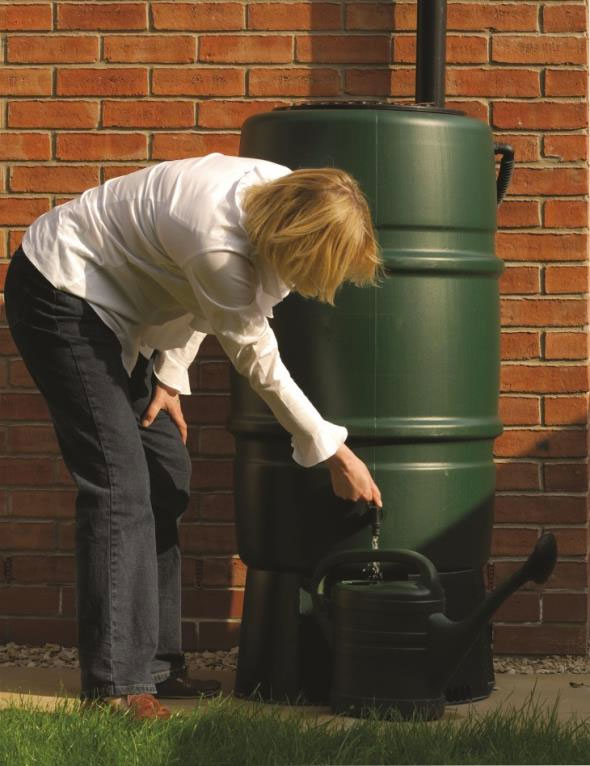
Rainwater harvesting is the practice of collecting and using rainwater from hard surfaces such as roofs for landscape irrigation or toilet flushing. A rainwater harvesting system can be as simple as using a rain barrel or installing a large cistern. Capturing rainwater at your home or business reduces drinking water otherwise needed for irrigation and helps reduce runoff from entering our combined sewer system during storm events.
Rebate Program Details
All SFPUC customers can qualify to receive a rebate of up to $100 for each rain barrel purchased and installed, maximum of two (2) rain barrels allowed or up to $350 for the purchase and installation of one (1) cistern with a holding capacity between 205 and 5,000 gallons.
-
Eligibility Requirements
- The applicant must have an active SFPUC water service account or obtain approval by the account holder (the water account number for the installation site is required to apply) for the property where the rain barrel or cistern is installed.
- The property is located in San Francisco.
- If the water account holder does not own the property, a Property Owner Approval Form signed by the property owner is required.
- Properties that previously received a discounted rain barrel or cistern through the SFPUC Rainwater Harvesting Program within the last 5 years, please contact waterconservation@sfwater.org or call 415-551-4730 prior to submitting an application.
How to Participate
Review these steps, take the required training, and make sure you have compiled the documentation required to get a rebate before you apply.
Step 1 - Review the SFPUC’s resource materials.
FAQs and other materials linked under the Resource section below provide detailed information on how and where to install rain barrels and cisterns.
Step 2 - Review the Program Terms & Conditions and Release of Liability.
Terms and Conditions
- Application for a rebate must be submitted within 90 days of the purchase date and installed prior to submitting an application.
- You must meet the following eligibility and documentation requirements:
- Install and maintain the rain barrels or cisterns per guidance provided in the SFPUC’s resources below and the manufacturer’s installation instructions.
- Installed rain barrel(s) or cisterns must comply with California Plumbing Code Chapter 16.The rain barrel(s), cistern, and a diverter kit shall be connected to a downspout or other effective means of capturing concentrated flow from roofs or other impervious surfaces.
- Rain barrel capacity must be a minimum of 50-gallons.
- Cistern storage capacity must be between 205 – 5,000 gallons.
- NOTE: Cisterns over 5,000 gallons in size require a licensed civil engineer to design the foundation and seismic support. A permit from the San Francisco Department of Building Inspection is also required for cisterns of this size. The SFPUC’s rebate only applies to cisterns under 5,000 gallons.
- For disconnected downspout installations, the rain barrel(s) or cistern must be equipped with an overflow hose that shall direct excess rainwater away from adjacent buildings and/or properties and flow to a sewer service drain or landscape area with appropriate drainage requirements.
- The rain barrel(s) or cistern shall not be connected to the potable water system.
- The rain barrel(s) or cistern cannot be a portable or collapsible device (e.g., garbage bin or soft-sided container).
- Collected rainwater shall be utilized by a hose or bucket/watering can.
- The rain barrel(s) or cistern shall be placed on a solid and level foundation such as concrete pad, pavers, or bricks. Cisterns over 500 gallons must be installed over a concrete pad or compacted gravel foundation.
- The rain barrel(s) or cistern shall not block or restrict access to walkways or pathways.
- The rain barrel(s) must have mosquito-proof screen with mesh less than 1 millimeter in size covering the top of the rain barrel or a tight-fitting impervious lid.
- Install a debris excluder or first-flush diverter on downspout for cisterns.
- Affix the required warning label that indicates the water is non-potable and is not for drinking. The SFPUC provides labels free per request, or you can make or obtain your own.
- The SFPUC endeavors to issue a rebate check within 8 weeks of final approval of an eligible rebate.
- Submission of an application constitutes an applicant’s acknowledgment and agreement that the applicant shall comply with these Terms and Conditions.
Rebate Agreement – Release of Liability
The SFPUC may deny any application that does not meet the requirements. The applicant agrees to allow the SFPUC to inspect the installed rain barrel(s)/ cistern as a potential condition to obtaining a rebate under this program. Funding for this program is limited to available resources. Rebates are processed on a first come, first serve basis.
SFPUC shall bear no responsibility or liability for the cost, expense, operation, maintenance, or repair of a rain barrel or cistern. SFPUC shall likewise bear no responsibility or liability for delay in accepting an application, rejection of an application, or termination of the program.
Step 3 - Purchase your rain barrel(s) or cistern and save receipts.
Save the receipt (s) that shows what you paid for the rain barrel(s) or cistern.
Step 4 - Install and photograph your device(s).
Take two photos of your installed rain barrel(s) or cistern, including a photo of the downspout. If your photos aren’t sufficient, we may require a site visit to confirm your rain barrel(s) or cistern is installed and functioning properly.
Step 5 - Gather all necessary materials to complete online application as our portal cannot save partial applications.
Please have the following information:
- SFPUC Water Account and Account Holder/Name on Water Account Installation Address
- Applicant’s contact information (name, phone, email)
- Receipt(s) that shows the itemized amount you paid to purchase each rain barrel or the cistern (receipts can be uploaded as photos or scans in pdf format).
- Provide a photo(s) that shows the installed rain barrels or cistern.
- Submit a simple diagram with your rebate to be considered for our Stormwater Credit.
Step 6 - Apply online for your rebate.
- If you haven’t applied for any previous SFPUC conservation assistance, you’ll be prompted first to register for our application portal.
- Click APPLY NOW and complete the application. Partial applications cannot be saved in our system.
- After completing the online application, send a completed and signed IRS Form W-9 to the San Francisco Controller’s Office. You can email them to supplier.management@sfgov.org or you can mail a hard copy to: Supplier Management, 1 Dr. Carlton B Goodlett Place, Room 300, San Francisco, CA 94102.
Rebates cannot be issued without a W-9 form on file with the Controller’s Office. This is because some people receive $600 or more in rebates from the City of San Francisco in a year. These people will receive an Internal Revenue Service (IRS) Form 1099 and may have to pay federal taxes. The Social Security number you provide in the application will remain confidential. The SFPUC operates under the terms of the Privacy Act. Social Security numbers will not be shared with people or organizations outside the Controller's Office. The SFPUC's request for Social Security or Tax ID numbers follows federal law. This law is the Federal Privacy Act of 1974, 42 UCS 405 (c) (2)(c).
For more information on this program or to request a hardcopy of our Rainwater Harvesting Manual, please email waterconservation@sfwater.org or call 415-551-4730.
Watch this video of how to install a rainwater harvesting system.
-
Frequently Asked Questions
Why use rainwater?
Rainwater harvesting systems can be as simple as using a barrel to capture water or as complex as installing a large underground cistern or storage tank. By capturing any amount of rainwater and reusing it, you can help reduce the need to use drinking water for landscape irrigation and toilet flushing.Is it safe to use rainwater?
Yes, rainwater is safe to use for watering plants. However, it is not advised to drink rainwater since most rainwater harvesting systems do not filter and disinfect the water collected from roof tops, which may contain animal poop or tar from roof shingles.How do I determine the size cistern or the number of barrels I need?
The size of your system depends on a number of factors: how big your roof is, how much space you have available for rainwater storage, and what you intend to use the water for. A rough rule of thumb is that you can collect 600 gallons of water for every 1,000 square feet of roof area for every inch of rain. San Francisco receives an average of 21 inches of rain per year, so for 1,000 square feet of roof that can add up to over 12,000 gallons of rainwater.How much water can I save using rainwater?
Water savings vary depending on the size of your rainwater harvesting system and annual rainfall.How much water can I save using rainwater?
Water savings vary depending on the size of your rainwater harvesting system and annual rainfall.Do I need a permit?
For rain barrels and cisterns, a permit is required if you need to disconnect a downspout that is currently connected to the sewer system. However, a permit is not required if you install a diverter kit that diverts rainwater into a rain barrel or cistern and, when full, flows back into the downspout and into the sewer system. Additionally for cisterns, if your downspout is disconnected from the sewer system you do not need a permit from DBI as long as your cistern meets the following requirements:- Cistern capacity is less than 5,000 gallons
- Height to width ratio is less than 2-to-1
- Captured rainwater is only used for non-spray irrigation
- Cistern is supported directly on grade
- Rainwater system does not require power or a makeup water supply connection
What extra steps do I need to take if I want to use rainwater for toilet flushing?
Indoor use of rainwater requires a permit from the DBI. For more information on indoor systems, please visit DBI’s website or call 415-558-6570.How long can I hold rainwater in my barrel or cistern?
As long as your rainwater harvesting system is opaque (of such color and thickness that sunlight cannot penetrate the barrel), shaded, and screened, and you use the water only for non-potable purposes, there is no strict limit on how long the water can sit in your system. Be sure to inspect your system often and clean it as needed. You can clean your system annually with a non-toxic cleaner such as vinegar. If you intend to water edibles with your rainwater, you must install a first flush diverter.What is a first-flush diverter?
It’s a device that diverts the first, most polluted flow of rainwater away from your rain barrel.Will my rainwater system run out of water during the dry months?
It depends on the size of your system. If you have enough space to accommodate a large cistern and your water needs are low, your catchment system could hold rainwater for all your summer needs. If you are using a small rainwater harvesting system, the rainwater will run out quickly. Anecdotally, a local SF rain harvester has reported capturing 60 gallons of water from a summer’s worth of fog and condensation from her roof!How much maintenance is required for a rainwater harvesting system?
Rain barrels and cisterns do not require much maintenance once they are installed. Here are simple steps to ensure your rainwater harvesting system functions as its best:- Inspect catchment area every six months to remove debris, algae growth, or any other obstruction from the surface.
- Before and after the rain season (typically Oct-Apr), ensure downspouts are clear, and clean roof gutters, screens, overflow outlets, and filters on your barrel to prevent clogging.
- Once a year, flush out any debris or buildup that may have accumulated on the bottom of the cistern. For tough buildup, you may scrub the bottom using vinegar or another non-toxic cleaner.
- Maintain clear access to the cistern and outlets for regular maintenance.
- Repair leaks or holes immediately.
Where can I get more information on the code requirements for installing a rainwater harvesting system?
Full code requirements can be found in Chapter 17 of the 2013 California Plumbing Code.Where can I take a course or learn more about rainwater capture and use?
The SFPUC sponsors free workshops which are held at the Garden for the Environment, a half-acre organic community garden located at the corner of Lawton Street and 7th Avenue. For a list of upcoming workshops, please visit the Garden for the Environment’s website.You can do more by …