

PFAS and Wastewater
Per- and polyfluoroalkyl substances are human-made chemicals that have become pervasive in the global environment and people's bodies due to their widespread use in consumer and industrial products. These chemicals are often referred to as PFAS. They are also called “forever chemicals” because they break down very slowly. Studies have associated high levels of PFAS exposure with adverse health effects.
The SFPUC is a water, power, and wastewater utility. The SFPUC has not found PFAS in San Francisco’s drinking water.
On the wastewater side, PFAS from homes, businesses, and office buildings is present in wastewater that flows into our sewer system. The SFPUC does not manufacture or add PFAS to wastewater in any way. We have found low levels of PFAS in San Francisco wastewater — lower than those found in many everyday consumer products and even household dust.
PFAS is a societal problem that must be addressed at the source by regulating the use of these chemicals in manufacturing. The SFPUC advocates for legislation to control these chemicals at the source through actions like support letters and participation in organizations like the California Association of Sanitation Agencies. This association leads many state efforts in source control legislation.
Lean more from our frequently asked questions below.
Frequently Asked Questions
-
What are PFAS, also known as “Forever Chemicals”?
Per- and polyfluoroalkyl substances, or PFAS, are a group of synthetic organic chemicals that are resistant to heat, water, and oil. They have been widely used in consumer and industrial products, as well as for emergency fire response. More than 15,000 PFAS compounds have been used as a surface coating, protectant, or for other purposes. Studies have shown that PFAS can accumulate and stay in the body for long periods of time and that elevated exposure to PFAS may lead to adverse health impacts. According to the Centers for Disease Control and Prevention, PFAS may contribute to decreased fertility, hormonal changes, increased cholesterol, weakened immune system response, increased cancer risk, and growth and learning delays in infants and children.
The two PFAS with the highest production volumes have been perfluorooctanoic acid, or PFOA, and perfluorooctane sulfonic acid, also known as PFOS. PFOA was used in the manufacture of consumer goods such as Teflon. PFOS was the key ingredient in the Scotchgard fabric protector and numerous stain repellents. In the United States, PFOA and PFOS were phased out in the early 2000s; however, they do not break down easily and are persistent in the environment. Furthermore, PFOA and PFOS are still produced internationally and can be imported into the United States in consumer products such as, carpet, clothing, packaging, home textiles, and non-stick cookware. During several national surveys, PFOA and PFOS were found in the blood of nearly all people tested. However, the Centers for Disease Control and Prevention have found that PFOA and PFOS blood levels have steadily decreased in U.S. residents since 1999.
-
Has the SFPUC found PFAS in San Francisco drinking water?
No. San Francisco Public Utilities Commission tests on San Francisco drinking water have not detected any PFAS compounds. Since 2012, five rounds of PFAS testing have been completed. No PFAS contaminants were detected. Learn more from this PFAS and Drinking Water Fact Sheet.
-
Has the SFPUC found PFAS in San Francisco wastewater?
Yes. PFAS from homes, businesses, and office buildings is present in wastewater that flows into our sewer system. The SFPUC does not manufacture or add PFAS in any way. We have detected low levels of PFAS in San Francisco wastewater — lower than those found in many everyday consumer products and even household dust. We have detected PFAS in San Francisco influent (the wastewater entering our treatment plants), effluent (the treated water discharged to San Francisco Bay or the Pacific Ocean), and biosolids (the treated solids recycled as fertilizer).
-
What are the sources of PFAS in San Francisco wastewater?
A San Francisco Estuary Institute study found that the majority of PFAS the SFPUC receives at our treatment plants comes from people’s homes, with some coming from businesses and office buildings. A University of California Irvine study found that laundry, urine, showers, and feces were the biggest contributors of PFAS to a household’s wastewater. This reflects the presence of PFAS in clothing (laundry) and in people's bodies (urine, showers, feces) as a result of the presence of PFAS in so many consumer products.
-
What is the SFPUC doing to address PFAS in wastewater?
The source of PFAS in wastewater is the ongoing use of many of these chemicals by manufacturers. This is where the issue needs to be addressed: by controlling the use of these chemicals at the source. Requiring wastewater utilities to solve the PFAS issue without addressing the source of the problem would mean asking ratepayers to foot the bill for a problem that manufacturers have created while allowing manufacturers to continue to profit from it. The SFPUC advocates for source control legislation through actions like support letters and participation in organizations like the California Association of Sanitation Agencies. This association leads many state efforts in source control legislation. The following legislation has recently been passed:
- AB 652 (Friedman 2021) bans PFAS in juvenile products
- AB 1817 (Ting 2022) bans PFAS in textiles
- AB 2771 (Friedman 2022) bans PFAS in cosmetics
- AB 1200 (Ting 2021) bans PFAS in food packaging
- SB 1044 (Allen 2020) bans PFAS in firefighting foam and certain equipment
- AB-347 (Ting 2024) Sets up an enforcement framework for existing and future PFAS restrictions
- AB-2515 (Papan 2024) bans PFAS in menstrual products
In 2025, though not required to do so by regulations, the SFPUC began regular testing of San Francisco’s wastewater for 40 PFAS compounds. We test wastewater influent, effluent, and biosolids at the Southeast and Oceanside Treatment Plants. We use the U.S. Environmental Protection Agency’s Method 1633.
The technology to remove or destroy PFAS from wastewater does not currently exist at the necessary scale, effectiveness, or cost-effectiveness to be a viable solution.
-
Is the SFPUC concerned about PFAS in biosolids used as fertilizer?
The SFPUC is closely monitoring information related to PFAS in biosolids and the use of biosolids as fertilizer. To date, this information does not indicate that the practice is unsafe given the levels of PFAS detected in San Francisco biosolids and the way they are applied as fertilizer on Northern California farms.
San Francisco biosolids are used to grow plants for livestock feed on Northern California farms. A University of California Davis study in these conditions found that the plants did not take up PFAS from the biosolids.
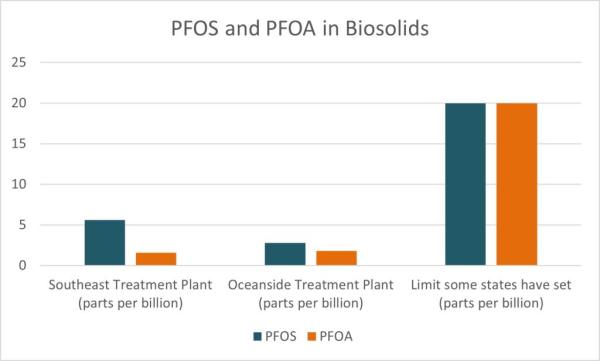
A number of other states have set 20 parts per billion as the threshold for levels of PFOA and PFOS (the two most prevalent types of PFAS, see first question) in biosolids at which actions are required to reduce levels. The levels of PFOA and PFOS found in San Francisco biosolids remain below this threshold, as shown by the below graph (data provided is from the most recent test in 2025).
The use of biosolids as fertilizer provides multiple environmental benefits:
- It replaces synthetic chemical fertilizer, which is environmentally destructive to produce.
- It out-performs synthetic fertilizers in terms of plant growth.
- It increases soil organic matter and sequesters carbon from the atmosphere, helping to mitigate climate change.
- It increases soil water holding capacity, meaning less water is needed to irrigate crops.
- It improves the health of soils, helping to preserve soil quality and prevent episodes of soil collapse, such as the Dust Bowl of the 1930s.
If San Francisco biosolids were not recycled as fertilizer, they would have to be buried in landfill. This would create large quantities of methane gas, a potent greenhouse gas that worsens climate change. It would also counteract the intent of current state laws aiming to reduce the amount of organic material that goes to landfill.
The use of biosolids as a renewable fertilizer is a practice closely regulated by the federal and California state governments and endorsed by the U.S. Environmental Protection Agency, the U.S. Department of Agriculture, and the Food and Drug Administration, as well as regional and local regulatory bodies. As yet, neither the EPA nor the California state government have issued regulations regarding PFAS levels in biosolids. As mentioned, levels in San Francisco biosolids remain below the thresholds set by some other states.
In January 2025, the EPA released a draft risk assessment for PFOS and PFOA in biosolids. The risk assessment does not establish any new regulations. It suggests health risks could be associated with low levels of PFOS and PFOA in biosolids, but the study used a model of biosolid land application significantly more intense than what is practiced in Northern California. If the EPA or the State of California determine additional regulation of biosolids is warranted, the SFPUC will do its part to meet any new standards. We remain committed to working with regulators, industries, and our community to find meaningful solutions that protect public health and the environment while supporting a sustainable future. -
Where can I learn more about PFAS and Wastewater?
- The California Association of Clean Water Agencies PFAS fact sheet
- The National Association of Clean Water Agencies biosolids webpage
- The U.S. EPA PFAS webpage
- The California Water Resources Control Board PFAS webpage
- Baywise webpage – PFAS: The Uninvited Guest
- Baywise webpage – What Are Biosolids?
- PFAS Central webpage (including PFAS-free products guide)
- Bay Area Biosolids Coalition
-
How can I help as a consumer?
As a consumer, you can avoid using products that contain PFAS, such as the following:
- Rain jackets – Choose products that are free of PFAS, heavy metals, PVC, and phthalate.
- To-go food containers – Avoid using this product as it often contains PFAS and consider bringing your own containers.
- Scotchguard – Avoid using this product.
- Floor waxes and cleaning products – Switch to chemical-free options and avoid purchasing carpets treated with perfluorinated compounds.
- Microwave popcorn bags – Avoid using this product as it often contains PFAS and use a microwavable glass container with a lid instead.
- Dental floss – Choose products made with cotton and natural waxes or silk.
- Car wax/polish – Avoid using this product as it often contains PFAS.
- Carpet – Avoid products claiming to be stain-, water-, or oil-resistant unless the manufacturer says they are completely fluorine-free.
- Furniture textiles – Choose products without stain-resistant coatings.
- Cosmetics – Choose products that don’t contain ingredients like Fluor, Fluoro, or PTFE.
- Non-stick cookware and cooking utensils – Avoid using this product. Beware of products that claim to be PFOS or PFOA-free; they may contain similar substitutes. Use cast iron and stainless steel cookware and wooden spoons and spatulas instead.
- Ski wax – Avoid using this product as it often contains PFAS.