

Lake Merced
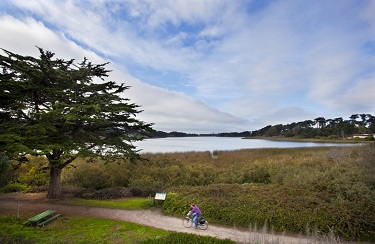
Lake Merced, located on the outskirts of San Francisco near Ocean Beach and Daly City, is a major fresh water, recreational, and natural resource for the City and County of San Francisco and the surrounding area. It is also an important stop for migratory birds on the Pacific Flyway. It is surrounded by two public golf courses - the nine-hole Fleming course and TPC Harding Park, host of the 2009 President's Cup and 2020 PGA Championship. More than half of the park is managed by the Recreation and Parks Department’s Natural Areas Program, which works to restore and protect habitat for birds and other wildlife, as well as to maintain and improve trails.
SF Recreation and Parks website.
Learn more about Lake Merced's Human and Natural History.
-
Stabilizing Water Levels in Lake Merced
Background
The San Francisco Public Utilities Commission (SFPUC) manages Lake Merced, a beautiful, coastal freshwater lake in the Southwest corner of San Francisco that is an important recreational and environmental asset and resource for the City and the entire Bay Area. The natural areas that surround the lake are home to many plants and animals, including many species of birds and waterfowl. Lake Merced is a destination for all kinds of recreational activities; from boaters, to hikers, bird watchers, bicyclists, picnickers, golfers and people who enjoy a peaceful day of fishing. Lake Merced is also a terminal lake. There are no other significant sources of water into the Lake other than direct rainfall. Declining water levels are a cause for concern regarding the long-term health of Lake Merced for recreational, ecological, and emergency water supply uses.
Stabilizing Lake Merced Levels
Working with our stakeholders and partners, we have implemented a multifaceted approach to address and manage decades of decreasing lake levels.Daly City Coordination
These efforts include development of recycled water to replace groundwater pumping for irrigation around the lake and advanced planning in coordination with the City of Daly City to implement the Vista Grande Project to divert treated and untreated stormwater to the lake during rain events. Learn more about the Vista Grande Drainage Basin Improvement Project.
Westside Enhanced Recycled Water
We are currently evaluating the potential to further increase and stabilize lake levels by utilizing available/excess supply from the soon to be completed Westside Enhanced Water Recycling Plant located at the Oceanside Wastewater Treatment Plant. The enhanced treatment process will produce water to safely irrigate Golden Gate Park, the San Francisco Zoo, the Lincoln Park Golf Course and other parks and open space areas of the City. This would potentially provide a year-round source of highly treated water for the lake not dependent on rainfall and allow us flexibility to maintain higher lake levels that support recreational uses and the habitat of this amazing watershed. -
Water Levels and Quality Monitoring
Lake Merced is considered a shallow eutrophic lake; meaning that it is rich in minerals and organic nutrients that promote proliferation of plant life including algae, which can lead to depressed dissolved oxygen levels. The lake is on the California 303 (d) list for pH and dissolved oxygen.
The SFPUC has conducted quarterly water sampling at Lake Merced since 1997 to monitor the condition of the lake. Starting in 2020 SFPUC also includes monitoring for harmful algal blooms as well.
View the sampling results and analysis here:
2020 Lake Merced Water Quality Monitoring Memorandum
2019 Lake Merced Water Quality Monitoring Memorandum
Lake Merced Levels
As part of the Watershed Management activities the SFPUC measures and records surface water levels at Lake Merced using an automated pressure transducer. Lake Merced water levels are recorded at least daily and are presented below.See the lake levels Hydrograph. The gap in data was the result of construction activities during the Seismic Upgrades and Retrofit of the Lake Merced Pump Station.
-
About Harmful Algal Blooms and Lake Merced
What is a Harmful Algal Bloom?
Algae are organisms that live in various water bodies. Under certain conditions algae and blue green algae (cyanobacteria) can grow very quickly in a short period of time and can cause harm to people, animals, or the local ecology. Harmful Algal Blooms (HAB’s) have become an increasing issue in urban lakes and reservoirs across California including Lake Merced.What does it look like?
Harmful algal blooms can look like foam, scum, algal mats, paint on the surface of water, or water that is green and has very low transparency. The harmful algae are generally concentrated at the surface but can exist at all depths of the water body. These blooms can produce toxins which at certain concentrations can be harmful to humans and animals, as well as produce unpleasant odors, caught fish not suitable for human consumption, and contribute to poor water quality.What is the SFPUC doing?
The SFPUC is coordinating with San Francisco Recreation and Park Department as well as the local Regional Water Quality Control Board (RWQCB), to keep the public notified of conditions in Lake Merced. The SFPUC monitors general water quality in the lake quarterly and monitors levels of cyanobacteria and potentially toxic algal by-products monthly. Results are reported to the RWQCB quarterly. San Francisco Recreation and Parks Department posts signage visible to the public in strategic locations around the lake to inform people of the potential threat level of water contact based on these monitoring results.Additional information can be found at: https://mywaterquality.ca.gov/habs/
-
Past and Future of 520 John Muir Drive (Former Pacific Rod and Gun Club Site)
Background
The property at 520 John Muir Drive adjacent to Lake Merced is owned by the San Francisco Public Utilities Commission and following redevelopment will be operated by the San Francisco Recreation and Parks Department.The property was previously operated as a skeet and trap shooting facility by the Pacific Rod and Gun Club from 1928 to 2014. As a result of these activities, upland soil at the Site was contaminated with lead and polycyclic aromatic hydrocarbons at levels that posed a potential risk to human health and the environment.
SFPUC implemented Phase I Remediation between 2015 and 2016 which included excavation and offsite disposal of approximately 88,000 tons of contaminated soil in the upland area. The SFPUC removed the contaminants from the site and restored the soil in order to protect both the health of the public and the Lake environment under the oversight of the San Francisco Bay Regional Water Quality Control Board. Phase II Remediation was completed between 2023 and 2025 and entailed lead and asbestos abatement and subsequent demolition of the remaining decrepit structures onsite, as well as excavation of remaining contaminated soils surrounding and underneath these structures. Phase II Remediation was completed in 2025.
The site is currently closed to the public and being utilized as staging for various SFPUC Capital Projects and the SFPUC’s Arborists currently in temporary trailers.
What is next for 520 John Muir Drive - Lake Merced West Redevelopment
The San Francisco Recreation and Parks Department proposes the future uses for the property as part of the Lake Merced West Redevelopment Project. The proposed project would offer an array of active and passive activities open to the public, such as trail use, picnicking, paddle boarding, kayaking, fishing, fitness activities, a ropes course, bird watching, space for outdoor exercise, skateboarding, multi-use courts for basketball and other activities, restaurant dining, and indoor space for gatherings such as community meetings and birthday parties. The facility would include areas that could be used flexibly for a wide variety of uses such as picnics, larger gatherings, or pop-up markets; as well as areas designated for programmed activities. The SFPUC’s existing Arborist Facility, housing offices and equipment storage, would be relocated from temporary trailers currently in the center of the site to a new set of buildings on the southeastern portion of the site.Status
The project completed environmental review under CEQA and the San Francisco Planning Commission certified a Final Environmental Impact Report (FEIR), Case No. 2019-014146ENV, on January 12, 2023 for the Site (SFPD, 2023). The site is currently closed to the public and being used for staging of various capital projects.