

Water Main Breaks
BACKGROUND
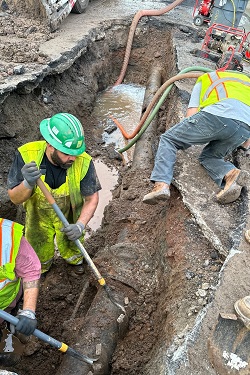
SFPUC operates and maintains 1,200 miles of water pipelines in San Francisco. Stretched end to end, these pipes, also called water mains, could stretch from San Francisco all the way to Dodge City, Kansas. Approximately 20% of San Francisco’s water pipes are about 100 years old, and made of cast iron. Many water mains are aging and nearing the end of their working life.
Although we have an active program to replace aging and vulnerable water mains each year, we are not able to prevent all water main breaks. On average, there are between 100 to 200 water main breaks in our system per year.
Water mains in San Francisco vary greatly in size – from 5 feet in diameter to 2 inches in diameter. The flow of water in these pipes is stopped, started, and slowed by valves -- a lot like the faucets at home.
SFPUC’s City Distribution Division personnel work 24/7 to monitor the system and respond to water main breaks, regardless of weather, holiday, or time of day.
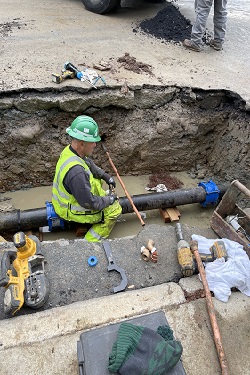
What Happens in a Typical Water Main Break
- A leak or rushing water from a potential main break is reported to our City Distribution Division, usually through 311.
- A senior valve operator – called a Gateman – drives to the scene to investigate and confirm a water main break.
- The Gateman contacts the Underground Service Alert system (USA) who will then send a field technician to mark all utilities, such as gas lines, prior to any digging. This may take some time, particularly if the break occurs at night.
- A foreman dispatches a Main Break Response Team to the site. The core Response Team includes: one foreman, two plumbers, a laborer, one truck driver and one backhoe operator. Additional staff such as machinists, carpenters to reinforce trenches, and welders might be needed depending upon the particulars of the water main break.
- The team usually establishes traffic control, such as flaggers and cones, high warning signs and arrow boards to safely direct traffic around the work area.
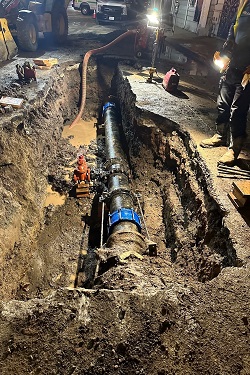
- An operator uses a backhoe to open up the street and dig out a hole above the broken water main. All materials are placed on a truck to be hauled away.
- The excavated pit is often filled with water. Crews use pumps to remove the water to allow personnel to inspect the main and diagnose the issue.
- Once crews identify a remedy, the Gateman will close the necessary valves to shut off water to the area around the broken pipe so that repairs may proceed.
- When this happens, water service to customers connected to the water main would be temporarily impacted. This might be low water pressure or no water pressure. Crews are careful to minimize the number of customers affected by a water main break.
- Crews either place a special clamp on the broken portion of the pipe or remove and install an entirely new piece of pipe to repair the break. The repair method varies depending upon the type of break and type of pipe.
- Crews disinfect and flush the new line and bring it back into service.
- When normal water service is restored, crews refill the hole, clean up, and put a temporary pavement patch on the work area.
- Final restoration in the form of permanent paving often occurs at a later date.
Frequently Asked Questions
-
Why keep water running through the broken water main? That wastes water.
Water system Operators must keep a minimum level of water pressure inside the main at all times in order to prevent contamination of the water main and maintain drinking water standards.
-
How long does a water main break take to fix?
From the time crews start digging the hole in the street, they usually complete repairs in approximately 4 to 6 hours.
-
What causes water main breaks?
Pipes usually break because of age or type of pipe. Cast iron pipes are the oldest and most vulnerable to breaks. Sometimes mains are accidentally hit by a contractor working in the area.
-
Why did a water main break in another neighborhood affect my water pressure?
San Francisco’s water distribution system has 24 pressure zones, which is based on topography, not geography. Often a single pressure zone spans pockets of customers throughout the City. Because of this, customers in a specific pressure zone may feel the impacts of a water main break located on the other side of the City.
-
My tap water looked brown after the main break was repaired.
If your tap water appears brown due to sediment stirred up because of the break, open the COLD water tap nearest to your meter (the sidewalk) and let it run for 3 to 5 minutes. A tub spout or garden hose bib is best. If it is still brown, wait one hour and repeat.