

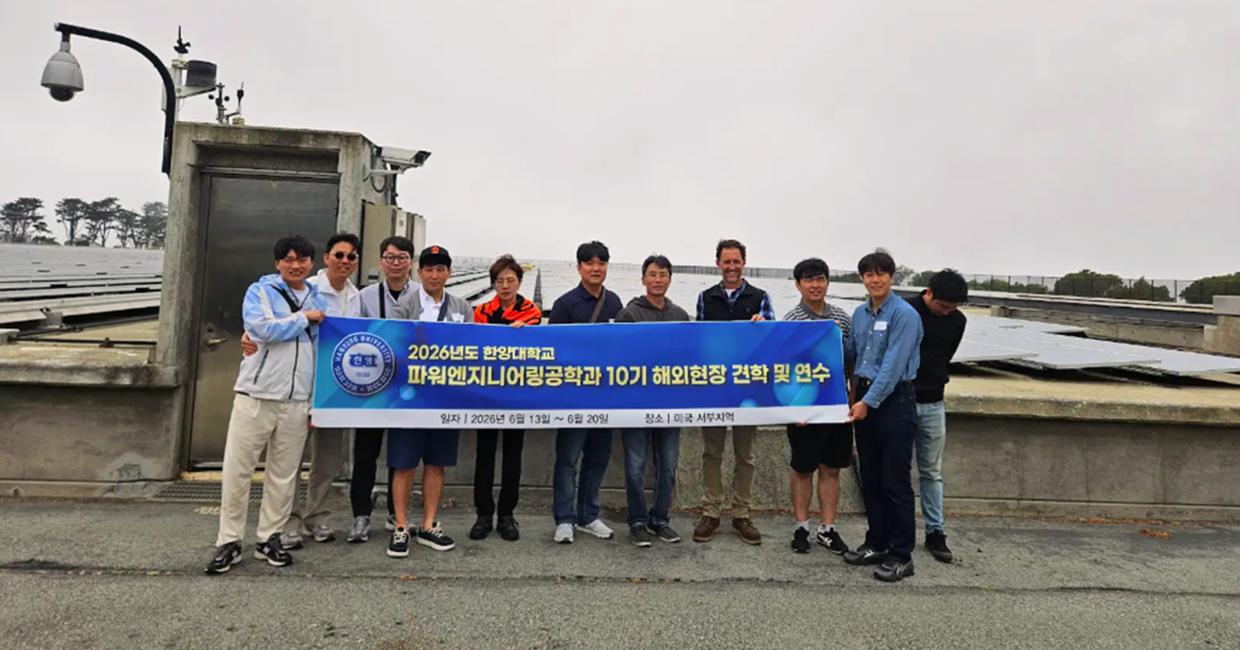
The San Francisco Public Utilities Commission's (SFPUC) Power Enterprise recently welcomed a group of graduate engineering students and professors from Hanyang University, one of South Korea’s most prestigious research institutions, with a warm “안녕하세요 (annyeonghaseyo),” or hello in Korean. The group learned about how San Francisco harnesses wind, solar, geothermal, and hydroelectric power to serve our customers, and also shared Korea’s history of deploying renewable energy solutions — reinforcing that building a clean energy future is a global effort.
From South Korea to San Francisco
The session kicked off with an overview of Hetch Hetchy Power and CleanPowerSF, the SFPUC’s two clean energy programs, which meet 75% of the electricity demand in San Francisco. The students were especially engaged by the discussion of energy transmission — how electricity moves from generation sites through the regional grid and into the city. Their curiosity sparked a dynamic Q&A, with questions about grid capacity, load balancing, and the technical infrastructure that supports San Francisco’s energy resilience.
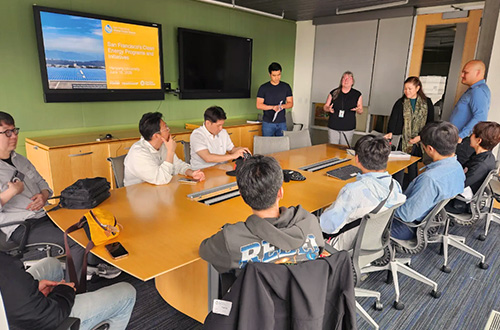
“As the world moves toward net‑zero emissions, we need more conversations like these to unlock new ideas and build the knowledge needed for a sustainable future,” said Elisa Rodriguez Furey, SFPUC Public Relations Officer. “The SFPUC is a nationally recognized leader on climate action, and we were glad to share our insights with Hanyang’s students and professors.”
Later in the day, the discussion was brought to life during a tour of the SFPUC’s solar array at the Sunset Reservoir. SFPUC Utility Analyst Michael Foley guided the visit and pointed out that the array is a five-megawatt system. As one of the largest municipal solar projects in the country, it provides clean electricity to thousands of people in San Francisco.
Building a Clean Energy Future Around the World
Hanyang University established the first engineering institute in Korea in 1939, and its main campus is in Seoul. This visit with the SFPUC was part of a larger trip the school organized to the Bay Area; the group also toured Stanford University and visited tech companies.
Earlier this year, South Korea announced plans to almost triple its operational renewable energy capacity 100 gigawatts by the end of the decade. The plan would aim for renewable energy to account for 20% of the country’s electricity generation by 2030, up from just 10.8% — including solar, wind, hydropower and biofuels — as of 2025.