

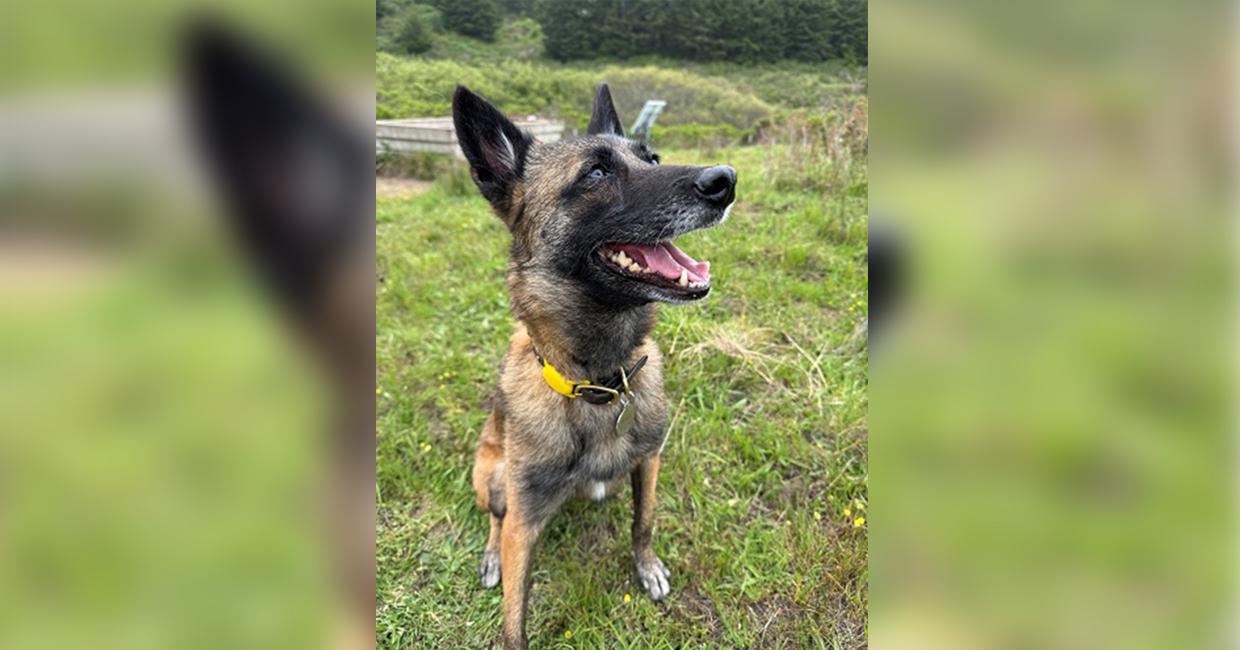
Last April, hikers on trails within the San Francisco Public Utilities Commission' s (SFPUC) Peninsula Watershed might have seen a brown and black dog methodically moving through the underbrush. Normally dogs are restricted on the Peninsula Watershed to protect the rare and endangered species there, but this dog is special. Species protection is her job. Meet Muon.
Muon is a scent detection dog whom the SFPUC helped train to detect San Francisco garter snakes. San Francisco garter snakes are highly endangered, elusive snakes that spend a lot of their time in burrows and/or in wetlands making them hard for biologists to detect. Fortunately, they use odors to communicate, making them trackable for a trained scent dog like Muon.
A More Efficient Method to Find Garter Snakes
Previously, when biologists from the SFPUC's Natural Resources and Lands Management Division wanted to make sure that there were no San Francisco garter snakes in a project area, they would have to dig up burrows to see if there were any snakes concealed inside. Muon’s method is more efficient and safer for the snakes. “When she finds the scent of a snake, Muon sits politely and waits for a treat from her handler,” noted Grace Shaw, SFPUC Biologist. “The handler marks the spot, notes it on a GPS tracker and moves on to the next area.”
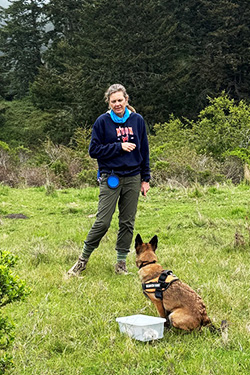
Muon’s tenure on the watershed is the result of years of work by the Natural Resources and Lands Management Division. Initially, SFPUC Senior Biologist Mia Ingolia was working with researchers at UC Berkeley to train scent detection dogs to find plant pathogens. It was through this work that the idea of using a specially trained dog to locate cryptic wildlife stuck with Mia. “It often happens that our hands are tied when it comes to special status species like the San Francisco garter snakes that may be found in burrows, tall grass and debris piles,” said Mia. “I knew that if we could develop a dog to sniff out the snakes, we would have another tool in the toolbox to manage projects and know which areas to avoid.”
Muon Puts Her Scent Detection to the Test
Mia and SFPUC biologists started working with dog handler Lauralea Oliver in 2022. The largest roadblock to training a scent dog often involves obtaining scent material for training. Through colleagues, SFPUC biologists learned about other agencies like the San Francisco Airport and the U.S. Geological Survey doing permitted San Fransico garter snake trapping and serendipitously obtained catch bags from those monitoring efforts. Additional fresh scents for future trainings were collected from live animals by gently rubbing cloth on them. More recently, Lauralea worked with the San Francisco Zoo to acquire scents from the snakes in their newly established breeding program.
Muon’s first actual field test came in July 2024 when crews cleared a large log pile that was suspected of sheltering San Francisco garter snakes. She patiently circled the wood pile as crews cleared it. Muon was accurate. The rest is history. Muon works on SFPUC watersheds multiple times a year now.
These Dogs Mean Business
Muon isn’t the only scent detection dog that works with Natural Resources and Lands Management. Another dog named Circe was used in the Alameda Watershed to detect western pond turtle nests. A rare species, western pond turtles bury their eggs near ponds and mark their nests with urine, which is easily detected by Circe who has been trained on the unique scent. “Healthy ecosystems produce clean water,” concluded Mia. “Species like these are important to help keep our watershed ecosystems thriving.”
The Natural Resources and Lands Management Division is considering other opportunities to use trained dogs as part of watershed management, potentially to detect rare plants and/or amphibians. So, move over, Lassie -- there are new dogs in town.