

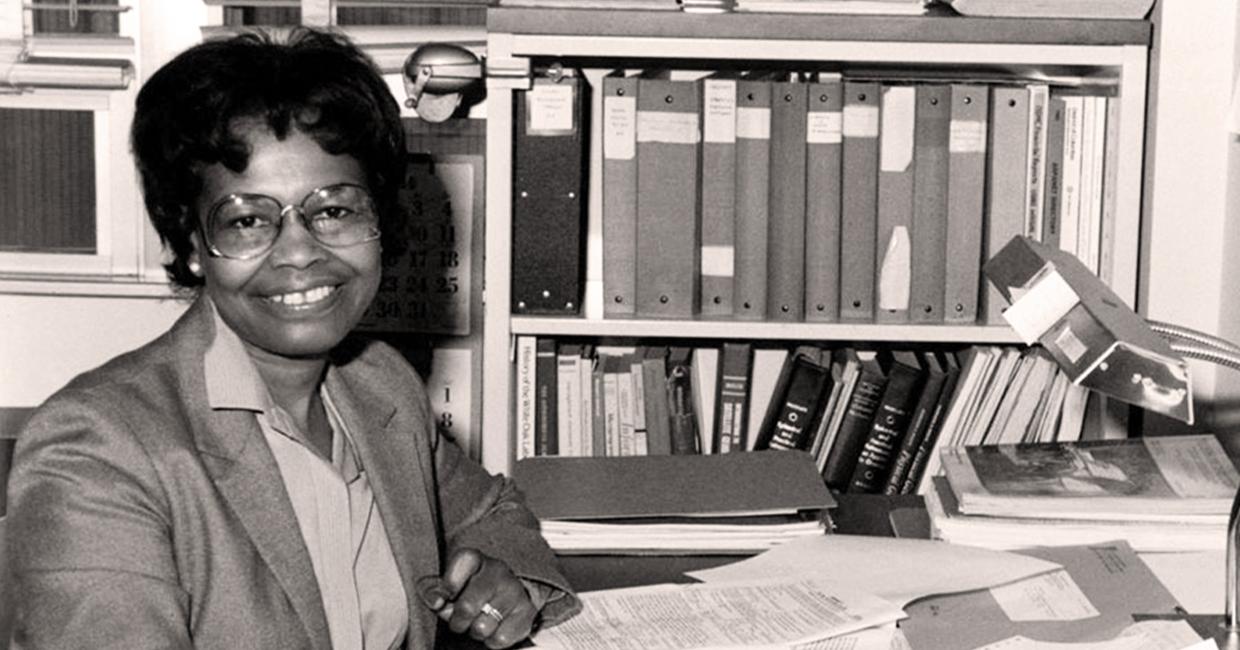
Every day, the San Francisco Public Utilities Commission (SFPUC) relies on data to keep essential services running safely, efficiently, and equitably. From mapping infrastructure to responding to emergencies, accuracy matters. But did you know that much of the technology that makes this work possible, such as the Global Positioning System (GPS), exists because of the groundbreaking contributions of a Black mathematician named Gladys West?
As we observe Black History Month, we recognize Gladys' remarkable story and the lasting impact of her work.
A Brilliant Mind Ahead of Her Time
Born in 1930 in rural Virginia, Gladys West grew up determined to use education as a path to opportunity. Excelling in mathematics, she earned a scholarship to attend Virginia State College, later obtaining a master’s degree in mathematics. In the 1950s, she began working at the U.S. Naval Proving Ground—an extraordinary achievement at a time when both women and people of color faced significant barriers in STEM fields.

At the Naval Proving Ground, which later became the Naval Surface Warfare Center Dahlgren Division, Gladys worked as a mathematician and programmer, helping analyze satellite data using some of the earliest computers. Her focus was geodesy, the complex science of measuring and understanding the Earth’s shape, size, and gravitational field.
For GPS to function accurately, satellites must know the exact shape of the Earth they are orbiting. Even tiny errors in Earth modeling can result in location inaccuracies of miles. Gladys helped solve this problem by developing precise mathematical models of the planet using satellite data.
Her work made it possible to determine exact positions anywhere on Earth. Government scientists developing GPS in the early 1970s incorporated the calculations done by Gladys and her team at the Navy’s weapons facility into the still widely used World Geodetic System, which enables GPS satellites to pinpoint precise locations on the planet’s surface. While GPS was originally developed for military use, it has since become a cornerstone of everyday life.
A Legacy That Guides Us Forward
Today, GPS plays a vital role in how the SFPUC carries out its mission. The technology supports faster and more effective emergency response, accurate mapping of utility infrastructure, and improved service planning and oversight. Each time GPS data helps pinpoint a service interruption, plan infrastructure improvements, or enhance coordination, it reflects the mathematical groundwork Gladys established decades ago.
Gladys West’s story reminds us that innovation often comes from those whose names are missing from history books—but whose work quietly shapes the world. This Black History Month, the SFPUC honors her legacy not only by remembering her achievements, but by recognizing how her brilliance continues to support the essential services we rely on every day.