

FOR IMMEDIATE RELEASE
April 22, 2026
SFPUC Contact:
communications@sfwater.org
The Salmon Are Back as the SFPUC Marks Earth Day
River stewardship, clean energy, and greener schoolyards among environmental accomplishments
SAN FRANCISCO – Chinook salmon returned to two Bay Area creeks this winter for the first time in decades. Steelhead trout populations are booming on those same two waterways. And the lower Tuolumne River is once again a thriving fish hangout.
It has been a good year for fish and other native species in waters the San Francisco Public Utilities Commission (SFPUC) helps manage.
The rebounding fish populations come as the SFPUC has worked diligently with other river partners – often for years – to remove man-made barriers to fish migration, restore natural spawning habitat, and strategically increase water releases from reservoirs to mimic natural river flows.
“This represents a lot of hard work by a lot of people. It’s paying off,” said SFPUC General Manager Dennis Herrera. “Together, we’re doing the work to protect and support native fish populations on the waterways we have a hand in managing. There’s more to come. On the Tuolumne River alone, we’re committed to not only providing more water for the river, but also significantly investing in restoring habitat through our proposed Healthy Rivers and Landscapes Program. As we mark Earth Day, it’s a reminder that healthy environments, clean energy, and healthy communities are all connected.”
Alameda Creek
Alameda Creek, which stretches from its mouth in the San Francisco Bay near Fremont all the way to Mount Hamilton in Santa Clara County, provides important habitat for native fish and wildlife. The Calaveras and San Antonio Reservoirs are important sources of drinking water for SFPUC customers, and the creeks upstream and downstream are important aquatic habitat for native species. Due to many factors — including the construction of flood control facilities, water diversion structures, and urbanization of open spaces — once-abundant steelhead trout lost access to the watershed and have struggled to survive in just a few areas over the past 70 years.
In the late 1990s, things began to change. The Alameda Creek Fisheries Restoration Workgroup, including the SFPUC, started to identify barriers to fish migration and making plans to remove them or construct fish ladders over them.
In 2006, the SFPUC removed Sunol and Niles Dams from Alameda Creek. The Alameda Creek Diversion Dam was rebuilt as part of the Calaveras Dam Replacement Project, including construction of a fish ladder in 2018. In January 2019 the SFPUC started releasing water from Calaveras Dam to support steelhead and other native species based on a schedule developed collaboratively with the Alameda Creek Fisheries Restoration Workgroup, including the California Department of Fish and Wildlife, National Marine Fisheries Service, and the Alameda Creek Alliance.
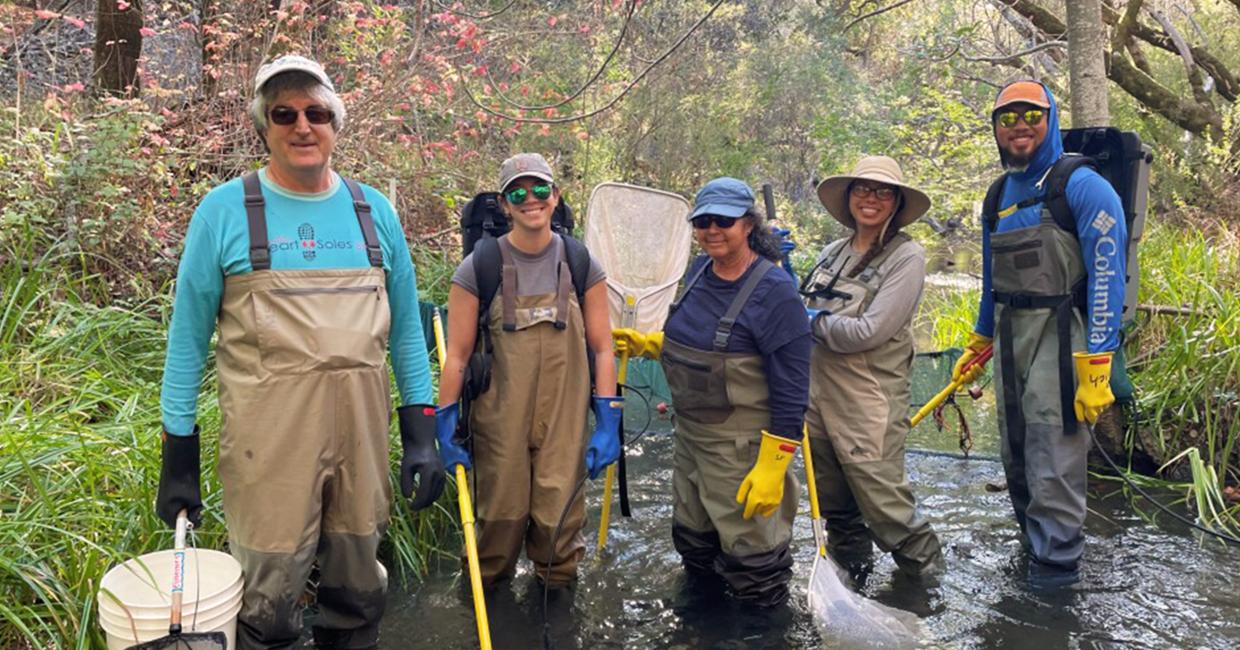
Now, due to decades of work by the SFPUC and other organizations to improve fish habitat and remove barriers, there has been an increase in juvenile steelhead leaving the watershed for San Francisco Bay and the ocean. During the SFPUC's annual fish trapping surveys between 2015 and 2023, biologists captured and released an average of about 40 steelhead a year. In 2024, they captured and released 2,600 steelhead. In 2025 that number was over 1,400. This year it’s already over 200 and on pace to meet last year’s figure. For the first time in more than 70 years, the adult steelhead can enter the watershed, and this past winter Chinook salmon were documented in the upper reaches of Alameda Creek.
San Mateo Creek
A similar story has been unfolding on San Mateo Creek on the Peninsula. In January 2015 the SFPUC started releasing water from Lower Crystal Springs Dam to support steelhead and other native species in San Mateo. This schedule also mimics natural flows and was developed in collaboration with the California Department of Fish and Wildlife and the National Marine Fisheries Service.
Over the last three years, the SFPUC’s capture and release of juvenile steelhead leaving San Mateo Creek has averaged almost 350 steelhead a year. Chinook salmon were also documented in San Mateo Creek this past winter for the first time in decades.
Upper Tuolumne River
The SFPUC is also advancing work on the upper Tuolumne River, downstream of O’Shaughnessy Dam in Yosemite National Park, the source for 85% of the Hetch Hetchy Regional Water System’s supply. Through its collaborative Upper Tuolumne River Ecosystem Program, the agency is shaping springtime snowmelt water releases to better mimic natural river flows, supporting rich and unique habitats and species downstream, including the wetland ecosystem in the Poopenaut Valley, and species such as rainbow trout and the foothill yellow-legged frog.
Lower Tuolumne River
On the lower Tuolumne River below Don Pedro Reservoir, the SFPUC in partnership with the Turlock and Modesto Irrigation Districts, the U.S. Fish and Wildlife Service, and River Partners has been working to develop and begin implementation of several projects designed to improve spawning and rearing habitat for Chinook salmon and rainbow trout. In 2024 this partnership led to the implementation of the Old La Grange Bridge Project, which created seven acres of new spawning habitat for fall-run and spring-run Chinook salmon. It will also help maintain other restoration projects as 50,000 cubic yards of new spawning gravel moves slowly downstream.
This year, the partnership aims to build another spawning habitat project – Powerhouse Riffles – just upstream of the Old La Grange Bridge Project. And in the next few years, the partners will work toward bringing 77 acres of new floodplain rearing habitat online to give juvenile salmon their best chance at growing and surviving their challenging migration to the ocean.
In May of 2025, the lower Tuolumne River saw around 1,000 spring-run Chinook salmon arrive for the summer and later successfully spawn, with thousands of juveniles beginning their migration to the ocean over this past winter. The arrival of such a large number of spring-run was a first for the Tuolumne. It is hopefully a trend that will continue as these habitat projects are built, and monitoring continues on the health of both spring-run and fall-run Chinook salmon populations. So far in 2026, 30 spring-run adults have arrived, with more expected through May and June.
All of this work is vital as the Turlock and Modesto Irrigation Districts and the SFPUC work to balance the needs of the river ecosystem and water supply reliability for the millions of people and thousands of businesses in the Bay Area and Central Valley who rely on the river for water.
Powering Cleaner Homes
Just as healthy rivers are essential to a reliable water supply, clean air is critical to healthy communities.
The SFPUC delivers this through two not-for-profit power programs: Hetch Hetchy Power, which has produced 100% greenhouse gas-free electricity for more than 100 years for municipal services like libraries and Muni; and CleanPowerSF, the City’s clean energy program that procures renewable electricity for homes and businesses.
Through CleanPowerSF, San Francisco provides clean electricity while saving customers more than $146 million on their electric bills over the past decade compared to PG&E.
Now CleanPowerSF is making it easier for customers to switch to clean electric appliances, helping reduce pollution, lower energy costs, and create healthier indoor air. Residential customers can receive bill credits for upgrades ranging from $150 for an electric stove to $300 for an electric clothes dryer to $1,200 for a heat pump water heater or HVAC heat pump. Additional incentives are available for income-qualified households.
Rooftop Solar for San Francisco Schools
While playgrounds get greener, the SFPUC is putting school rooftops to work, generating clean energy that reduces emissions and helps protect the health of San Francisco’s children and communities. Since 2012, the SFPUC–SFUSD partnership has installed nine rooftop solar systems across the district. On average, these systems generate about one-third of a school's annual electricity needs, helping supplement on-site power use and support reliable operations.
Greener Schoolyards
Many San Franciscans remember the asphalt schoolyards where recess was spent. Over the next 40 years, the SFPUC is partnering with the San Francisco Unified School District to transform these spaces into green, multi-use spaces that support play, learning, and stormwater management.
At Everett Middle School that shift is already complete. What was once two acres of cracked asphalt is now a vibrant campus with rain gardens and permeable surfaces that capture up to 1 million gallons of stormwater each year, easing pressure on the City’s sewer system.
National Recognition
The SFPUC’s work is also earning national recognition. The agency recently received its fourth Envision Award in the last six years from the Institute for Sustainable Infrastructure, this time for the Sunol Valley Water Treatment Plant Ozonation Project, which is adding ozone treatment to improve taste and reduce odors in drinking water. Other award-winning projects include the Headworks and Biosolids Digester Facilities at the Southeast Treatment Plant (2019, 2022), as well as the Treasure Island Water Resource Recovery Facility (2025).
About the San Francisco Public Utilities Commission
The San Francisco Public Utilities Commission is a department of the City and County of San Francisco. It delivers drinking water to 2.7 million people in the San Francisco Bay Area, collects and treats wastewater for the City and County of San Francisco, and meets 75% of the electricity demand in San Francisco with clean energy. The SFPUC’s mission is to provide customers with high-quality, efficient and reliable water, power, and sewer services in a manner that values environmental and community interests, and sustains the resources entrusted to the agency's care. Learn more at sfpuc.gov.