

Home Test Kits
Quick Summary
Drinking water test kits are widely available at stores and on the internet. These home kits allow customers to check their drinking water quality at their tap. There are different kits to test for different issues. You can test for harmful substances and for hardness, and alkalinity. This webpage provides more information about home test kits.
What Are Home Test Kits?
Drinking water test kits (aka, home test kits) are widely available at hardware stores and the internet, allowing customers to independently assess their drinking water quality at their tap. These kits provide several tests, including: pesticides, bacteria, lead, copper, nitrate, nitrite, iron, chlorine, pH, hardness, and alkalinity.
Some kits utilize test strips with color charts to estimate concentrations. Other tests utilize a presence/absence (positive/negative) system based on the appearance of one or two lines on a test strip. Finally, bacteria tests involve the formation of gas bubbles and color change after a
48-hour period.
Are Home Test Kits Reliable?
Home test kits can provide reasonable approximations for the test parameters. However, home test kits can sometimes produce misleading results, such as when a color strip or indicator line doesn’t fully develop. It is also possible that the kit result is misinterpreted by the kit user.
While some home test kits can reliably detect lead from home plumbing fixtures, some kits can provide variable results depending on the brand and contaminant. Even if the kit involves sending a sample to a laboratory, some products utilize laboratories that have not been certified and use methods that should not be relied on to make decisions about safety. Home test kit results should be considered an initial step, not a final result. A poor water quality result by a kit should be confirmed with follow-up analyses by a laboratory that uses state-of-the-art instruments, certified methods, and quality control measures to ensure accuracy and reliability.
SFPUC Home Kit Evaluation
In late 2018/early 2019, SFPUC conducted an evaluation of three brands of home test kits. The evaluation was based on over 400 tests, including both kit and laboratory methods and found that overall, the kits provided reasonable agreement with laboratory methods. The evaluation found:
- For coliform bacteria, nitrate, nitrite and iron greater than 80% agreement with lab for all three brands.
- For pesticides, lead, copper, and chlorine greater than 80% agreement with the lab for two brands but data quality problems were seen with one of the brands.
- pH measurement was less than 60% agreement with the lab for two brands, while one brand agreed between 60% and 80% with lab results.
- Total hardness and alkalinity measurements were less than 60% agreement with the lab for all three brands. This poor performance was likely because the soft waters served by the SFPUC Regional Water System have very low levels for total hardness and alkalinity, and concentrations were at the low end of the kits’ detection levels. Follow-up tests with waters of moderate-to-high hardness produced acceptable hardness and alkalinity results (greater than 80% agreement with the lab) by all three brands.
What If I Need Help Interpreting a Home Kit Result?
See below for tips on interpreting home test kit results. SFPUC can support interpretations of home test kit results over the phone. Call 311 and ask to speak with a drinking water quality inspector.
What If a Home Kit Produces a Poor Water Quality Result?
Follow-up testing by a California certified laboratory is recommended. For lead, San Francisco residents may request a sampling kit and analysis for a small fee of $25 by applying here link or calling 650-652- 3100. Women, Infants & Children (WIC) Program participants can request a free lead test. This tap water sampling is conducted by the resident according to a sampling procedure provided by us. SFPUC will pick up the collected sample, conduct analysis, and provide results to the resident
For contaminants other than lead, if a San Francisco resident can demonstrate (e.g., with a photo) that a home test kit produced a result above a health-based drinking water standard, SFPUC will conduct a follow-up laboratory measurement at the home tap, at no cost and provide the result to the customer. Call 650-652-3100 to arrange sampling.
Performance summary from SFPUC home kit evaluation*
| Parameter | Performance (3 brands) |
|---|---|
| Pesticides (atranzie/simazine) | Mixed |
| Total Coliform Bacteria | Good |
| Lead | Mixed |
| Copper | Mixed |
| Nitrate Nitrogen | Good |
| Iron | Good |
| Total Chlorine | Mixed |
| pH | Poor/Mixed |
| Total Hardness | Poor |
| Akalinity | Poor |
*Conducted on San Francisco drinking water, 2018/2019
SFPUC Sampling & Interpretation Guidelines for Home Test Kits
Positive/Negative Strips
Of the home test kits evaluated by SFPUC, all three brands utilized positive/negative strips for lead and pesticides (atrazine/simazine). It is important that the strips are read in the proper direction. Examples of inconclusive, negative, and positive results are provided below. These tests were part of the SFPUC Home Kit Evaluation, 2018/2019. The positive pesticide result, shown below, was determined to be a false positive via laboratory testing (i.e., the kit reported a positive, even though pesticides were not present in the sample).
 | Inconclusive (no result, test did not perform properly): no lines or very light lines |
 | Negative: left line (near 1) darker than right line (near 2), OR only left line appears |
 | Positive: right line (near 2) darker than left line (near 1), OR lines equally dark |
Bacteria Tests
Proper sample collection is a key part of any bacteria test on drinking water, as a sampler must avoid introducing bacteria into the test vial. When collecting bacteria samples at home, customers should avoid touching, coughing, or sneezing on any part of the inside of the test vial or water that will be part of the test. In addition, test water should be taken directly from a flowing kitchen tap and not from a water pitcher or glass.
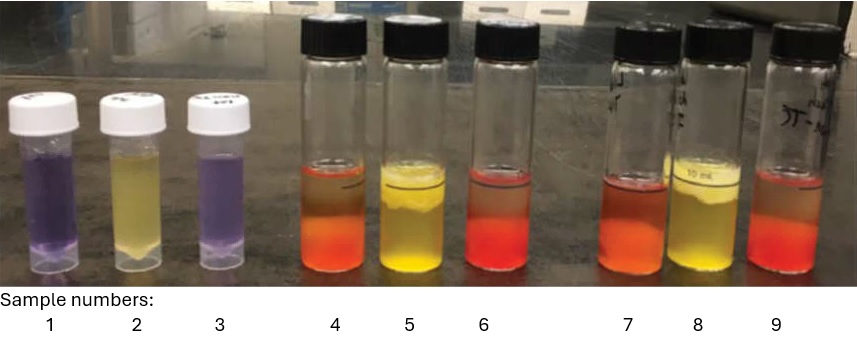
To interpret tests, customers should wait the entire incubation time (typically 48 hours but could vary by home test kit). For the kits evaluated by SFPUC, yellow indicated a positive result (see samples 2, 5, and 8, below). Some test kits also showed a positive result via gas bubble formation at the top of the test fluid (see samples 5 and 8, below).
Total coliform bacteria tests by three brands of home test kits, evaluated by SFPUC in 2018/2019 (from left to right, samples 2, 5, and 8 intentionally spiked with coliform bacteria by SFPUC’s laboratory to evaluate the performance of different brands of kits).
We’re Committed to Quality: Our highly trained chemists, technicians and inspectors consistently monitor the water we serve—throughout our system, every day of the year. For additional information and materials, please visit sfwater.org/quality. For questions about YOUR water, please call 311. You can also visit 311.org.
February 2023