
Lead and Drinking Water - Tips for Schools
Quick Summary
Lead is a type of metal. People can get sick if they eat or drink something with lead in it. Unfortunately, in the past they used lead in water pipes because lead is flexible and doesn't rust. The San Francisco Public Utilities Commission doesn't use lead in the water pipes that deliver water around the city. In the 1980s we removed lead pipes that connect to the water meter. The plumbing in homes, schools, stores and offices is privately owned. Privately owned plumbing sometimes has lead in the pipes or joints. This page offers steps you can take to keep lead out of drinking water in your building.
Tips for Schools
Lead can enter drinking water through corrosion of lead-based plumbing materials. Corrosion is a process that dissolves or wears away metal, caused by a chemical reaction between water and lead-based plumbing materials. Buildings built before 1986 are more likely to have lead pipes, lead-containing fixtures, and/ or solder containing lead. Therefore, some fixtures may dispense water with detectable lead concentrations. Threshold lead levels, which have been established by different federal, state, and local agencies, are those above which corrective actions may be required.
Below are some threshold levels for lead in drinking water established by appropriate agencies and adopted by some school districts:
- 10 μg/L (ppb) Lead Action Level (effective on November 1, 2027) for tap sampling based on U.S. Environmental Protection Agency’s Lead and Copper Rule Improvements (LCRI),
- 5 ppb, a special Lead Action Level for schools based on the LCRI, and
- 1 ppb, based on American Academy of Pediatrics recommendation for lead in drinking water.
The following sections describe some measures to help reduce exposure to lead in tap water.
Permanently Shut Down the Faucet or Fountain (Tap)
If feasible, the simplest approach is to permanently shut down or isolate a high lead water tap. Provide alternate drinking water sources such as from other taps with lead levels below the desired threshold value.
Replace Plumbing Components
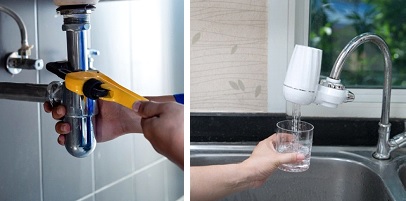
If only temporary shutdown is feasible, plumbing components with lead should be replaced. If it is suspected that a faucet is high in lead (e.g., due to its age), it should be replaced immediately with a lead-free faucet or bottle filling station. The new lead-free faucet or filling station, once installed, should be flushed and then be used for non-drinking or non-food preparation purposes until a lead test from the new tap is below the desired threshold value.
If faucet replacement fails to reduce lead levels, SFPUC will provide lead testing at the meter. If lead levels are low at the meter, the source of lead must be from interior plumbing, between the meter and the new faucet. In this scenario, replacement of old plumbing on the property is recommended. The replacement costs for internal plumbing vary, and the property owner or facility operator should consult a licensed plumber for the cost estimate.
If Detected, These Actions Will Reduce or Eliminate Lead in Faucet or Fountain Water:
- Permanently shut down the tap
- Replace plumbing components
- Install a water filter
- Daily flushing
Make sure that the person who does the repair or replacement work on the internal plumbing system uses only lead-free solders and materials. The U.S. Safe Drinking Water Act and California regulations require that only lead-free materials be used in new plumbing and plumbing repairs.
Install a Water Filter
You can install an NSF certified water filter to remove lead. These filters come in different configurations and can be installed in different locations, such as mounted at the outlet of a tap, installed in the supply line under the sink, or installed at the supply line entering the property or building. Cost of lead-removal filters vary and the price information for the desired filter can be obtained from suppliers or vendor websites.
 | Be careful, not all filters will remove lead. NSF International, an independent, third-party certification organization, has developed a standard for testing and certifying the performance of treatment devices for lead removal (NSF Standard 53 and NSF Standard 58). Before purchasing any device, ask the manufacturer or vendor for proof of NSF certification and the Performance Data Sheet, or check by visiting the NSF website. |
| Be careful, follow all the manufacturer’s installation and maintenance instructions diligently if a filter is used for lead removal. Timely filter replacement is important. |
Conduct Daily Flushing
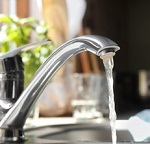
If other options are not viable, then a temporary option is to conduct daily flushing at taps with a high lead result until a permanent corrective action can be implemented. The contact time of water with lead-based plumbing components contributes to the elevated lead levels in water. Flushing out stagnant water regularly helps keep lead levels low.
A daily flushing program may be used to clear the pipes and fixtures where lead levels are high in the property. Flushing involves opening high lead taps every morning before any water usage to flush out the water that has been standing in the interior pipes and/or the fixtures since their last significant use.
Flushing should also be conducted whenever a high-lead tap has not been used for more than 6 hours. The flushing time varies by the type and location of the fixture being cleared. A quick and simple way to assess sufficient flushing is an appreciable water temperature change.
While this flushing protocol is generally recommended for single-family properties, a large property such as a school, daycare center, or a campus with multiple buildings may need to establish its own flushing program that contains the following tasks:
Testing to Establish Needed Flushing Times
Before any water uses in the morning, flush the high-lead taps:
- Locate the tap furthest away from the service line on each wing and floor of the building where high-lead levels have been detected. Fully open the taps for a high flow rate, and let the water run for 10 minutes. The 10-minute time frame is generally adequate for most buildings. Then flush the specific taps to be tested as specified in b, c, or d as appropriate.
- For kitchen taps (and other taps where water will be used for drinking and/or cooking), open the taps and let the water run for 1 minute, or until cold.
- For drinking water fountains without refrigeration units, let the water run for about 1 minute, or until cold.
- For drinking water fountains with refrigeration units, let the water run for 15 minutes (to flush out all the water that has been sitting in the refrigeration unit).
Daily Flushing and Recordkeeping
- Carry out the established flushing program each day; repeat when you want to use a tap that has not been used for more than 6 hours to keep the water fresh in the pipe.
- Facility maintenance staff are recommended to record all flushing activities in a log that is submitted daily to the person in charge of the flushing program.
Flushing is only a short-term, temporary remedy; the long-term solution is to replace all lead-containing components in the plumbing system, including the water taps. If changes are made to the plumbing, the need for and required extent of flushing should be re-evaluated.
More information can be found at:
- State of California, Division of Drinking Water, School Lead Sampling Webpage
- U.S. Environmental Protection Agency, 3Ts For Reducing Lead in Drinking Water in Schools
- National Science Foundation Certified Drinking Water Treatment Units and Water Filters Webpage
We’re Committed to Quality
Our highly trained chemists, technicians and inspectors consistently monitor the water we serve—throughout our system, every day of the year. For additional information and materials, please visit sfpuc.gov/waterquality.
For questions about YOUR water, please call 311. You can also visit sf311.org.
December 2025