
Lead and Your Drinking Water - Planned Improvements to Water Service Lines
Quick Summary
Lead is a kind of metal. People can get sick if they eat or drink something with lead in it. Unfortunately, in the past they used lead in water pipes because lead is flexible and doesn't rust. The San Francisco Public Utilities Commission doesn't use lead in the water pipes that deliver water around the city. Privately owned plumbing sometimes has lead in the pipes or joints. You can more about how we remove lead for service lines with the information on this page.
We’re Making System Upgrades
Prior to 1950, water utilities around the country commonly used lead service lines and components to connect water mains to the services lines for homes.
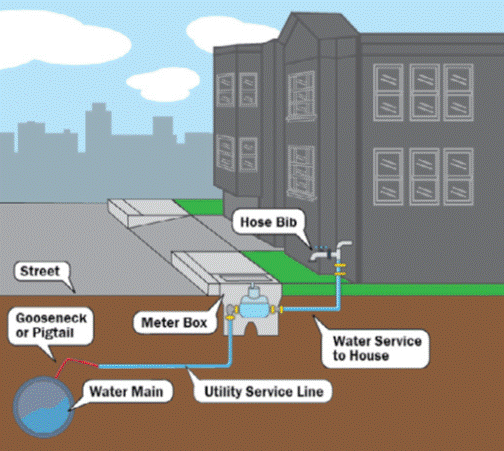
In the 1980s, SFPUC removed all known lead utility service lines (approximately 7,000 lines) and does not expect to find additional lead service lines in the water system. If any are found, they will be quickly removed. However, there are galvanized utility service lines that use flexible lead components to connect to the water main. These flexible lead components, commonly called goosenecks, pigtails, or whips, are approximately 3 feet in length and may contribute low levels of lead to drinking water (see diagram). Under Senate Bills 1398 and 427, the State of California required utilities to inventory and then remove these lead components in 10 years. SFPUC is in the process of removing any remaining lead components and removing all galvanized utility service lines downstream of the lead components as a part of the effort. As of July 2025, 85% of the planned replacements have been completed over 4 years ahead of schedule.
Your Drinking Water Meets Water Quality Standards
Yes, SFPUC drinking water consistently meets all federal and state drinking water standards. This includes lead testing every 3 years under the Lead and Copper Rule (LCR). Under the prior LCR lead action level, lead levels must be below 15 μg/L (parts per billion, ppb) in 90% of the samples collected. The LCR was recently revised under the Lead and Copper Rule Improvements (LCRI), effective on December 30, 2024, requiring lead levels to be below 10 ppb in 90% of the samples collected effective on November 1, 2027. All LCR results, from 2009 to 2024, are in full compliance and can be found here sfpuc.gov/lead.
The California Public Health Goal for lead in drinking water is 0.2 ppb. The SFPUC strives to have no detectable lead levels in drinking water provided to customers. Therefore, the State requirement to remove lead components supports the overall goal of no detectable lead levels in drinking water.
Upgrades Began in 2020
San Francisco has approximately 180,000 utility service lines. In 2023, field investigations were completed to identify service lines for lead components. As of July 2025, the removal of lead components and galvanized service lines are ongoing with 85% completed of the planned replacements. Less than 250 planned replacements remain and will be completed by mid-2026, 4 years ahead of the State’s 2030 deadline. If you are impacted by this program, SFPUC will contact you approximately 2 months prior to the upgrade for your property to provide a specific schedule for your property and instructions to follow during and after the upgrade.
The Impacted Areas Are Shown On Our Map
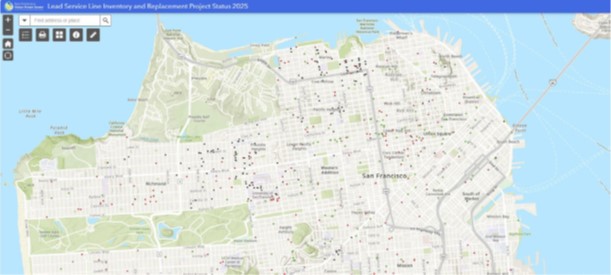
Based on current SFPUC records, residents who may be affected by this program are identified on a GIS map located at sfpuc.gov/lead. This map identifies Utility Galvanized Requiring Replacement locations. If the utility service line is not galvanized (e.g. copper, plastic, etc.), the service line replacement will not be needed. The GIS map will be updated periodically based on these findings. Based on field studies, only a fraction of these addresses are likely to have lead components, also called pigtails.
Actions for Residents to Take During These Upgrades
The upgrade can temporarily disrupt water quality at your property. All water quality impacts will be short-term. Water quality should return to normal within a month of construction. However, to mitigate any change in water quality due to construction disturbances, SFPUC will provide instructions to flush taps within your property immediately after construction, and will provide a drinking water pitcher with a 6 month supply of replacement filters at no cost.
The SFPUC also plans to remove all galvanized utility service lines downstream (between the meter and the water main), of the lead components or pigtails as a part of the effort. Residents should consider replacing any galvanized water service line connected to the property (the portion of the water service line between the meter and the building).
Questions?
SFPUC lead programs, including the LUSL Replacement Program, are summarized at sfpuc.gov/lead. SFPUC Water Quality Division can be contacted at (650) 652-3100 or sfpuc.gov.
References:
State Water Resources Control Board Service Line Inventory (SLI) Status Map
State Water Resources Control Board – Customer FAQ - LUSL
We’re Committed to Quality
Our highly trained chemists, technicians and inspectors consistently monitor the water we serve—throughout our system, every day of the year. For additional information and materials, please visit sfpuc.gov/waterquality.
For questions about YOUR water, please call 311. You can also visit sf311.org.