

Onsite Water Reuse
Contact Email: nonpotable@sfwater.org
IMPORTANT: Draft Rules & Regulations Now Open for Public Review
The San Francisco Department of Public Health (SFDPH) has published draft Rules and Regulations Regarding the Operations of Onsite Treated Non-potable Water Systems. The public comment period runs from September 24 to October 26, 2026.
JOIN OUR PUBLIC WORKSHOP: SFPUC and SFDPH will host a public workshop on Wednesday, October 14, 2026, at 10:30am PT at 525 Golden Gate Ave and available virtually. The workshop will provide an overview of the Rules and Regulations and an opportunity to ask questions and submit public comments.
View the draft Rules and Regulations, submit comments, and RSVP for the workshop.
Purpose
The Onsite Water Reuse Program allows for the collection, treatment, and use of alternate water sources for non-potable applications in individual buildings and at the district-scale.
Who Must Comply?
Onsite water reuse systems are required for new development projects of 100,000 gross square feet or greater in San Francisco.
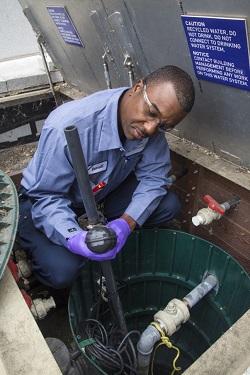
Onsite water reuse systems represent a significant opportunity to transform the way water is managed in buildings. By matching alternate water sources with the right end use, such as irrigating landscapes and flushing toilets and urinals, onsite water reuse systems offset valuable potable water supplies and unlock the potential for more resilient and sustainable water management. The SFPUC administers the Onsite Water Reuse Program, which allows for the collection, treatment, and use of alternate water sources for non-potable applications in individual buildings and at the district-scale. Properties with onsite water reuse systems are required to obtain a permit from San Francisco Department of Public Health. San Francisco is also part of a national effort through the National Blue Ribbon Commission to overcome barriers to onsite water reuse.
Requirements
Onsite water reuse systems are required for new, large development projects in San Francisco. Recently amended in 2021, Article 12C of the San Francisco Health Code (commonly known as the Non-potable Water Ordinance) requires the following:
- New development projects that apply for a site permit after January 1, 2022 of 100,000 gross square feet or more are required to install and operate an onsite water reuse system.
- New development projects of 40,000 gross square feet or more are required to submit water budget calculations assessing the supply available from the required alternate water sources and the demand from required non-potable uses, outlined above. It is not required to install and operate an onsite water reuse system.
Required Alternate Water Sources and Uses
| Building Type | Required Alternate Water Sources | Required Non-potable Uses |
|---|---|---|
| Commercial |
|
|
| Residential and Mixed-Use |
|
|
Note: Requirements for projects that submitted a site permit after January 1, 2022
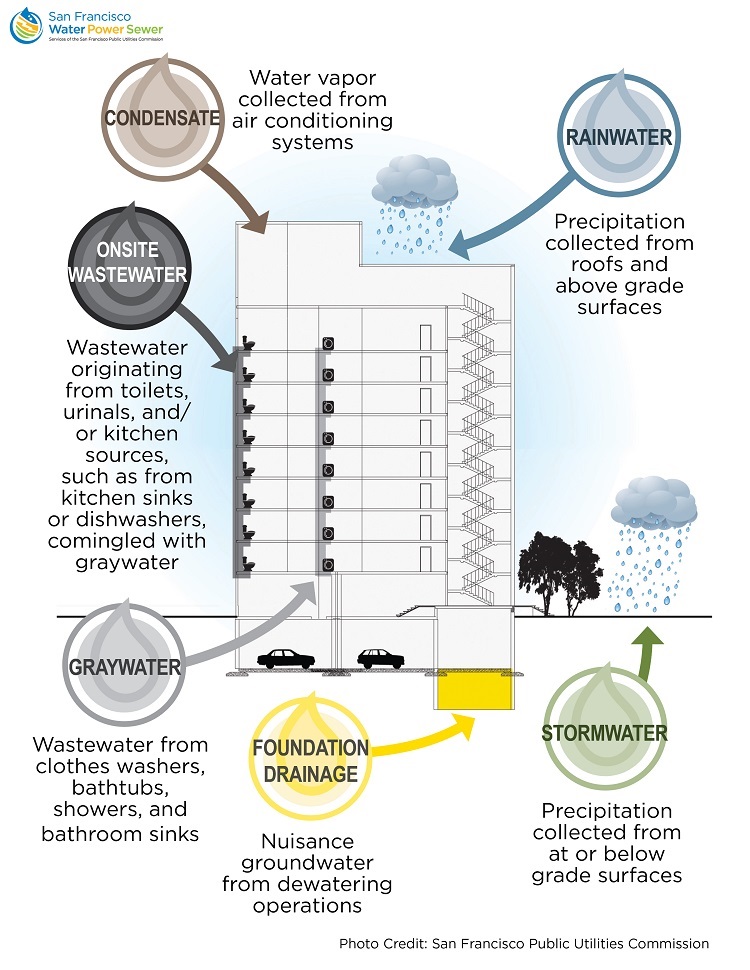
Interface with DBI's Building Permit Process
Development projects planning to install an onsite water reuse system must submit their Water Budget Documents to SFPUC prior to submitting a building permit application to DBI. Learn more by reading about the two submittal processes.
Grant Program
SFPUC’s Onsite Water Reuse Grant Program provides funding to support the implementation of onsite water reuse systems in the city. Depending on expected water savings, projects may be eligible for grant funding from $200,000 to $1,000,000, depending on potable offset. For more details, read the Grant Program Rules.
Applications will be temporarily paused as of August 1st, 2026, while program rules are updated; the grant program is expected to reopen by late 2026.
Capacity Charges and Excess Use Charges
Effective February 1, 2017, customers with onsite water reuse systems may receive an adjusted water and wastewater capacity charge. This adjustment will accurately assess capacity charges for buildings with onsite water reuse systems by charging new users only for the demand placed on SFPUC water and wastewater systems.
SFPUC also implements the NPO Excess Use Charge Program for new development projects required to comply with Article 12C. More info can be found at sfpuc.gov/NPOExcessUse.
For more guidance on how to implement an onsite water reuse system in San Francisco, please see the Onsite Water Reuse Program Guidebook.
-
How Do I Comply?
- Submit a Water Budget Application and Water Use Calculator to SFPUC-Water Resources Division (SFPUC-WRD).
- Submit a Non-potable Implementation Plan to SFPUC-WRD (district-scale projects only).
- Submit Application for Permit to Operate to San Francisco Department of Public Health- Environmental Health (SFDPH-EH).
- Obtain Encroachment Permit from San Francisco Public Works (SFPW) if applicable.
- Obtain Plan Check Approval from San Francisco Department of Building Inspection-Plumbing Inspection Division (SFDBI-PID) and SFDPH-EH and Complete System Construction.
- Conduct a Cross-Connection Test with SFPUC-Water Quality Division (WQD) and Complete Post-Construction Inspection.
- Submit Documentation for a Permit to Operate from SFDPH-EH.
- Obtain a Permit to Operate from SFDPH-EH.
- Operate in Conditional Startup Mode.
- Operate in Final Use Mode with SFDPH-EH Approval.
-
Project Submittal Forms
-
Resources
Technical Resources:
- Onsite Water Reuse Program Guidebook
- SFDPH-EH Rules and Regulations
- Validated UV List
- Non Potable System Vendor List
- Guidebook for Commissioning an Onsite Water Treatment System
- CCSF Certified Backflow Testers
- Onsite Water Reuse Lessons Learned Guidebook
- Use of Alternate Water Sources for Cooling Towers Factsheet (Sep 2024)
- Get Ready for the Rain!
- Required Levels of Backflow Protection for Non-potable Water Systems
Case Studies:
- Case Studies of San Francisco Non-potable Water Projects (Sep 2024)
- Case Studies of Water Recycling Projects Around the World
- Case Studies of Innovative Water Reuse and Resource Recovery Projects
More Resources:
- Onsite Water Recycling E-Book 2022
- National Blue Ribbon Commission for Onsite Non-potable Water Systems
- Independent Advisory Panel for Single-Family Water Reuse Applications Report (December 2024)
- January 16, 2025 Webinar: Findings from the Independent Advisory Panel for Single-Family Water Reuse Applications Report
- Stormwater Management Ordinance (rainwater and stormwater systems)
- Co-Benefits of Onsite Water Recycling Report (available upon request: nonpotable@sfwater.org)
- Onsite Water Reuse Factsheet for Developers
- Onsite Water Reuse Factsheet for Occupants
View our webinars to learn key updates and technical guidance on implementing and operating an onsite water reuse system in San Francisco.
- Onsite Water Reuse Program Updates – Webinar (September 9, 2020)
- Decoding the Log Reduction Targets Part 1 and Part 2 – Webinar (September 23, 2020, and October 7, 2020)
- Lessons Learned – Webinar (October 21, 2020)
- Insights from Operators of Onsite Treated Non-potable Water Systems – Webinar (May 1, 2023)
- State of the Sciences Single Family Water Recycling Applications – Webinar (October 19, 2023)
- Co-Benefits of Onsite Water Reuse – Webinar (June 4, 2026)
-
Contact Information
SFPUC Onsite Water Reuse Program
Email: nonpotable@sfwater.org
Phone: 415-551-4734
Website: www.sfpuc.gov/npoSFPUC Water Quality Division Cross-Connection Control Program
Phone: 650-652-3199
Website: www.sfpuc.gov/construction-contracts/new-developments/cross-connection-controlSF Department of Public Health: Apply to Build a Water Reuse System
Email: dph.nonpotable@sfdph.org Phone: 415-252-3809
Website: www.sf.gov/step-by-step--apply-build-water-reuse-systemSF Public Works Encroachment Permits
Phone: 415-554-5810
Website: www.sfpublicworks.orgSF Department of Building Inspection - Plumbing Inspection Division
Phone: 628-652-3450
Website: Department of Building Inspection -
Map
Under SFPUC’s Onsite Water Reuse Program, there are 50+ completed onsite water reuse systems, including blackwater, graywater, rainwater, stormwater, condensate systems, and more.
Explore an interactive map of onsite water reuse systems
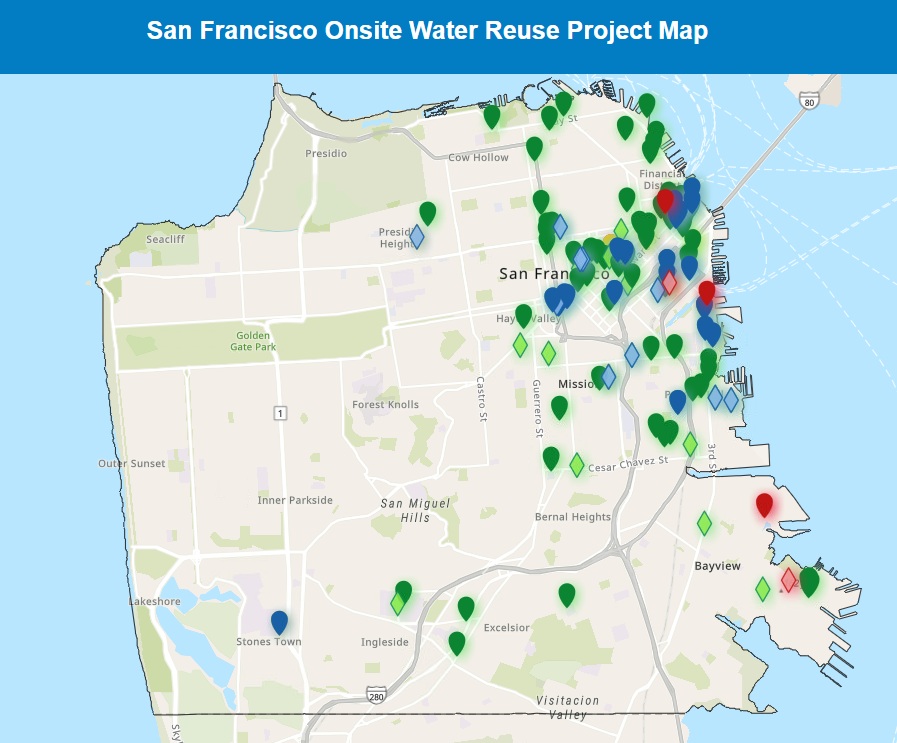
Note: This map is optimized for full-screen desktop displays. Some features may be limited on smaller screens or mobile devices