

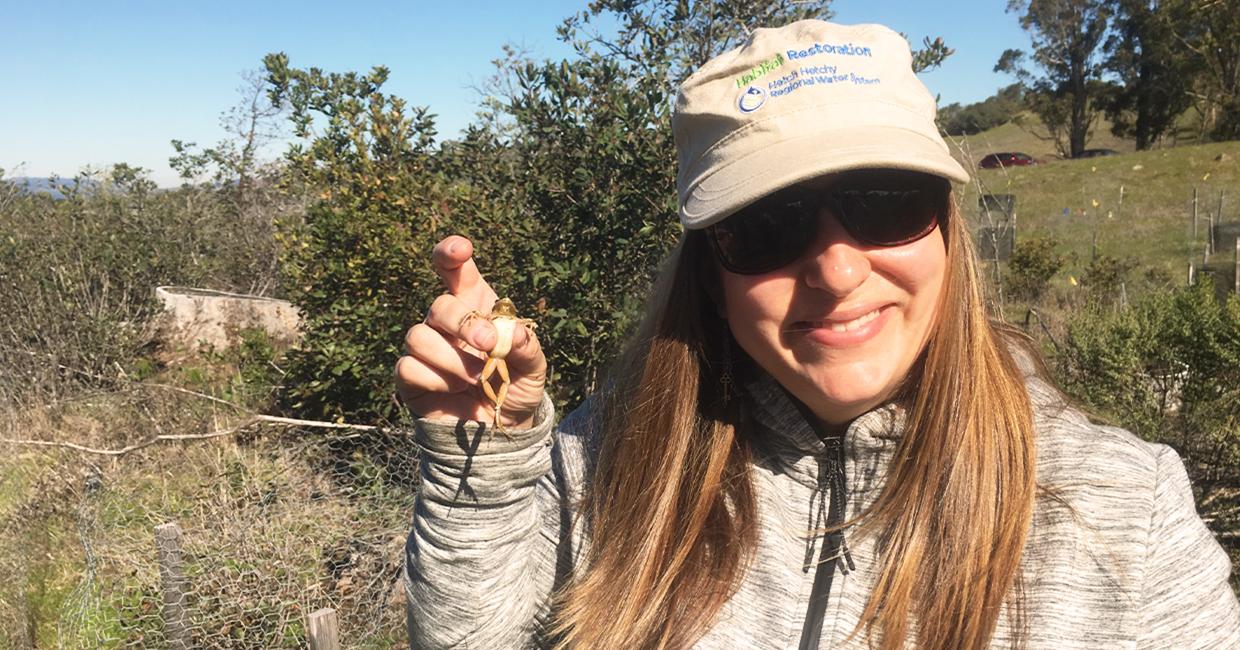
Growing up in rural central Illinois, Mia Ingolia didn’t live on a farm, but her backyard felt like one. Her family’s three-acre property was a patchwork of big gardens, flower beds, and a pond bordered by farm fields, forests, and horse pastures. Summers meant planting seeds with her dad, cutting bouquets for the dinner table, and getting sent to the yard by her mom with the instruction: “Go play outside.”
Play, for Mia, often meant exploring. She caught frogs and turtles at the pond, climbed trees, paddled canoes, and rescued stray kittens. “It was always my job to pick strawberries and grapes,” she remembers. “Honestly, I think I ate way more strawberries than I ever brought back to the house.”
That country childhood planted seeds that would grow into a lifelong passion. Today, Mia is a Senior Biologist for the San Francisco Public Utilities Commission's (SFPUC) Water Enterprise’s Natural Resources and Lands Management Division, where she helps steward more than 61,000 acres of protected watershed lands across the Bay Area.
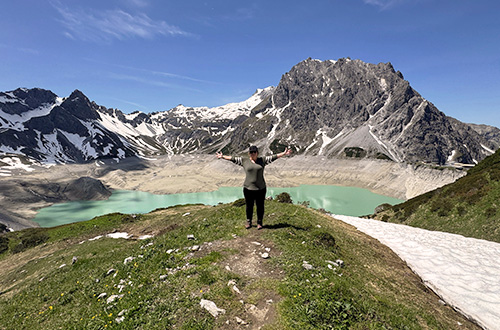
Her journey from a strawberry-stained kid to scientist has taken her across continents and ecosystems. As part of her coursework, professional experience, and personal travel, Mia has traveled to lagoons in the Ecuadorian Amazon rainforest, wetlands in Australia, wildflower meadows in New Zealand, and alpine slopes in the Austrian Alps where she recently found and gleefully photographed an alpine salamander. “They can live nine years and stay pregnant for four,” she says, still sounding delighted.
Turning Passion into Profession
In college, a horticulture class at the University of Illinois revealed a new path. “I realized I could study plants and ecosystems and not have to go into farming like everyone else around me.” That discovery led to graduate school at UC Davis, where she studied environmental horticulture and habitat restoration. Her master’s thesis focused on the rare Tahoe yellow cress, a plant that grows only on the sandy shores of Lake Tahoe and is at risk of extinction.
When her graduate advisor unexpectedly passed away, Mia pivoted into a student job at the UC Davis Arboretum that grew into a decade-long role as curator of a 100-acre plant collection that supports research and showcases California native plants and the plant species of Mediterranean climates around the world by teaching students and the public about environmental stewardship and sustainable landscaping. She built plant collections, mentored students, and pioneered digital mapping systems now used at major institutions like the San Diego Zoo.
Her work also took her to Australia, where she collaborated with Monash University on seed dispersal research across more than 1,000 wetlands. She collected seeds, analyzed data, and even brought species back to expand the Arboretum’s Australian collection.
Protecting California’s Native Plants
Mia joined the SFPUC in 2015 alongside a cohort of six other new biologists. Since then, she’s led projects across the SFPUC’s managed lands, from creating the Sunol Native Plant Nursery and the Alameda Creek Watershed Discovery Garden in Sunol to working on endangered species conservation and restoration projects in the Alameda and Peninsula Watersheds.
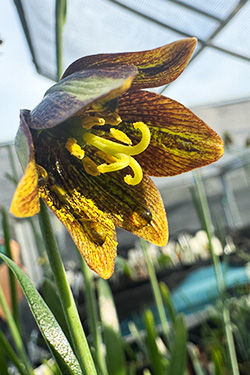
One project especially close to her heart centers around the restoration of the Hillsborough chocolate lily, a fragile native plant with fewer than 1,000 individuals left in the wild. Mia and her team fenced off the habitats to protect them from being eaten by deer, removed invasive species, collected seeds, and carefully grew the lilies in the SFPUC Sunol Native Plant Nursery. “For years we didn’t know if they would even bloom in the nursery,” she says. “Then in year five, we got 44 flowers. Fewer than five bloomed in the wild that year.”
Her research partnerships with the U.S. Forest Service and universities like UC Berkeley, UC Davis, and California State University bring even more expertise to the challenge of safeguarding California’s biodiversity. “Our Mediterranean climate, soils, and topography support species that are found nowhere else,” she says. “I feel strongly about honoring that and finding ways to give back. Especially in the face of human impact.”
The Girl Who Never Stopped Exploring
For all her professional accomplishments, Mia still lights up when she talks about small wonders: frogs, salamanders, and newts. “If I wasn’t a plant person, I’d be a herpetologist,” she admits.
She dreams of one day returning to live in the mountains, maybe the Sierra Nevada, or maybe even Sicily, where her family roots run deep. Until then, San Francisco is home, and her days are spent balancing the patience of science with the curiosity of a kid who once pulled apart milkweed plants just to see the sap. “I just happened to turn my passion into my job,” Mia says with a shrug. “And I got lucky in that sense.”